
EN 12150 is the European standard governing thermally toughened soda lime silicate safety glass. It specifies minimum fragmentation requirements that must be met before glass products can be certified as "safety glass" and sold in the European market.
In short: if a sheet of tempered glass breaks, the resulting fragments must be small and relatively uniform to reduce the risk of serious injury. EN 12150 defines exactly what "small enough" means — and how to measure it.
Why Does EN 12150 Exist?
Ordinary annealed glass breaks into large, sharp shards that can cause severe lacerations. Tempered glass — also called toughened glass — is heat-treated to break into small, relatively blunt fragments instead. This property is what makes it suitable for applications where human contact is likely: car windows, shower screens, glass doors, and building facades.
EN 12150 was developed to standardize how manufacturers demonstrate that their glass actually behaves this way. Without a clear, measurable standard, claims of "safety glass" would be unverifiable.
What Does the Standard Actually Require?
The core requirement of EN 12150-1 is a fragment count test. When a glass specimen is broken, the number of fragments within any 50×50 mm (5×5 cm) area must meet a minimum threshold based on the nominal glass thickness:
| Nominal Thickness (mm) | Minimum Fragment Count (per 50×50 mm) |
|---|---|
| 3 – 4 | ≥ 15 |
| 5 – 7 | ≥ 40 |
| 8 – 12 | ≥ 30 |
| 15 – 19 | ≥ 10 |
| ≥ 20 | ≥ 5 |
In addition to fragment count, the standard restricts the presence of large "splinters" — fragments that are too elongated and could still cause cutting injuries.
How is the Test Performed?
The standard test procedure involves:
- Placing a conditioned glass specimen horizontally on a test frame.
- Breaking the glass with a pointed hammer at a defined impact point (typically 13 mm from a corner).
- Waiting for fragmentation to stabilize (usually a few seconds).
- Selecting the 5×5 cm reference area with the lowest fragment count (the worst-case zone).
- Counting every fragment within that area.
The Problem with Manual Counting
For decades, step 5 was performed by a trained operator physically counting fragments — often with a magnifying glass and a marker pen. This approach has well-documented problems:
- Speed: Manual counting of a single specimen can take 20–45 minutes.
- Consistency: Different operators produce different counts on the same specimen — studies show variance of 10–25%.
- Fatigue: Accuracy degrades significantly after the first hour of repetitive counting.
- Documentation: Generating a formal, auditable PDF report from a manual count requires additional administrative effort.
A single production line producing 500 sheets per day would require many hours of dedicated counting time just to meet EN 12150 sampling requirements — before accounting for re-tests or rejections.
How Automated Testing Solves These Problems
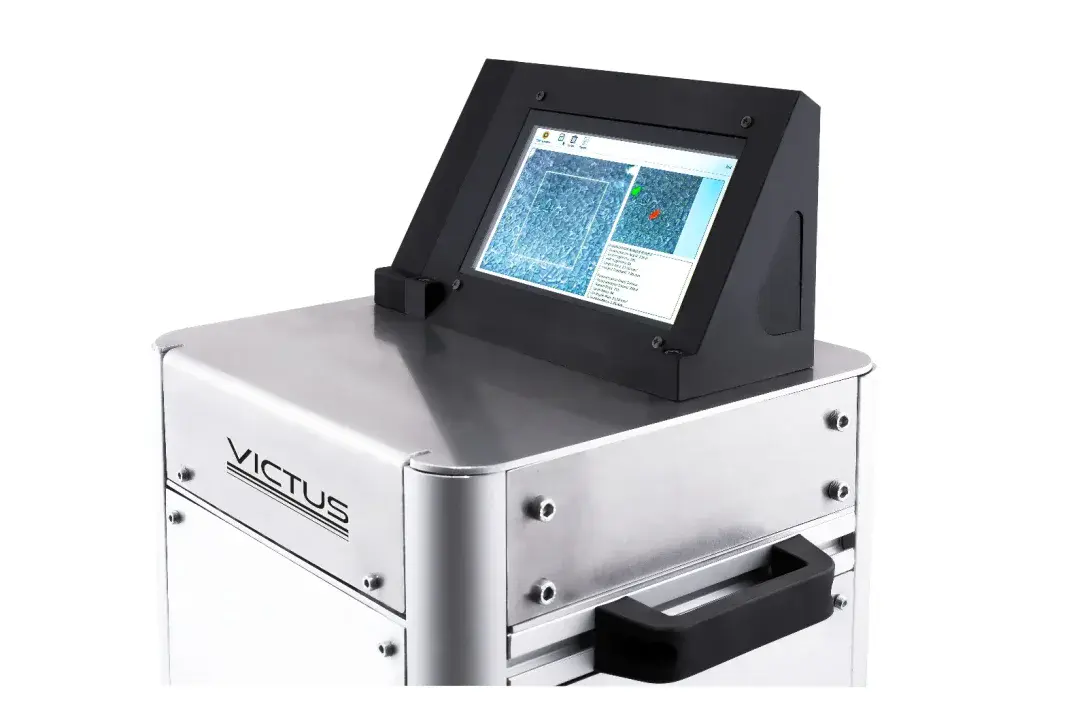
Automated glass fragmentation analyzers — like Atasaga's Victus device — use industrial cameras and computer vision algorithms to perform the entire counting process in 6–8 seconds per specimen.
The system captures a high-resolution image of the broken glass, segments individual fragments using trained AI models, counts all particles within the 5×5 cm reference zone, classifies fragment shapes, and generates a standardized PDF report — all without operator intervention.
The result is faster throughput, consistent and reproducible counts, and a complete digital audit trail.
EN 12150 vs. Related Standards
EN 12150 is part of a broader family of glass safety standards:
- EN 12150-1: Definition and description of thermally toughened glass.
- EN 12150-2: Evaluation of conformity / product standard.
- EN ISO 12543: Laminated safety glass.
- EN 14449: Laminated glass for buildings.
If you manufacture or import thermally toughened glass into the EU/EEA, EN 12150-1 and EN 12150-2 are the directly applicable standards for CE marking.